Science Victory: Research Pacing & Key Techs
Science Victory is the classic Civ route and remains one of the most reliable ways to win. The core idea is simple to state: push your research output to number one and finish the space-race projects first. In Civ VII the science win is decided in the Modern Age with a concentrated space-project sprint, but the research you bank beforehand sets the speed of that sprint.
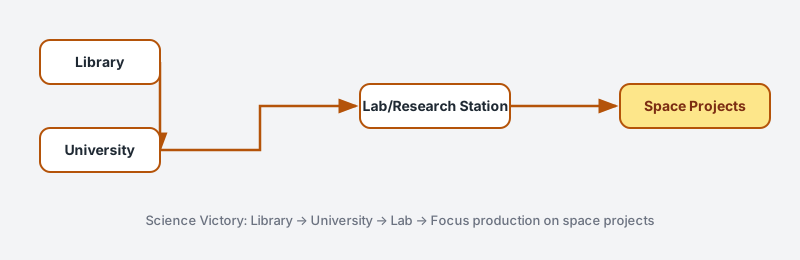
Research priorities
Staying ahead on research every Age is what wins. The shape of the tech tree decides your tempo, so know which branches to rush.
- Antiquity: rush the lines to Libraries (Writing) and Universities (Education); these buildings are the engine of science.
- Mid game: grab civics and policies that boost science, such as Rationalism doubling Campus adjacency.
- Late game: focus production on space-race projects; pre-unlock Rocketry and Fusion power.
- Science city-states (like Geneva) grant +1 science per envoy; rush suzerainty early.
- Keep tech and civic trees balanced so bonuses unlock together, not in isolation.
Key wonders and city-states
Wonders and science city-states that add research are force multipliers that visibly shorten the win clock, so prioritize them over flavor wonders.
- Great Library (Antiquity): free already-researched ancient techs — a key early lead.
- Oxford University (Exploration): +1 policy slot and a free tech — a mid-game explosion.
- Space Race Project (Modern): essential wonder for the science sprint.
- Befriend science city-states and send envoys; suzerain bonuses stack across the empire.
City and district planning
A science win needs at least 3-4 cities specialized in research. Each science city wants a Campus on a mountain-adjacent tile (+2 adjacency), a Library, University, and Lab, plus enough population to work specialist slots.
Age pacing
The science route is a long build, so schedule your districts and projects by Age rather than reacting turn to turn.
- Antiquity: settle 4 cities, each with a Campus + Library; finish the science Legacy Path.
- Exploration: upgrade to Universities, race Oxford University; target 80 science per turn.
- Modern: build Labs, launch space projects, target 200+ science per turn, finishing all projects in 5-8 turns.
Common mistakes
Science losses are almost always self-inflicted. Watch for these patterns before they cost you the game.
- Too few science cities: one or two cannot support the space projects; you need at least three specialists.
- Ignoring production: space projects need huge production; pair science cities with an industrial zone or factory.
- Getting raided: science builds weak armies; keep defensive units or sign non-aggression pacts.
- Late Campus placement: poor adjacency halves your science for the whole game.
Defending the science lead
A big science lead invites attack, because rivals know they cannot out-research you. Defense is therefore part of the strategy, not an afterthought.
- Keep a standing army of upgraded units even while sprinting space projects.
- Sign defensive pacts with the second-strongest science civ to deter the militarist.
- Build walls and a ranged unit in every border city as a minimum deterrent.
- Use spies to protect your space projects from sabotage in the Modern Age.
Remember that a single lost capital can halt your project queue for a dozen turns, so the gold spent on defense pays for itself the moment a rival decides you are not worth attacking.
Quick reference: buildings in order
If you only remember one thing, remember the build order: Library first for the science floor, University second for the multiplier, Laboratory third for the sprint, and the Space Race wonder last. Skipping any single step leaves a permanent hole in your output that no policy can fully close, so protect these build slots above almost everything else.