Leader & Civ Pairing Recommendations
The greatest freedom in Civ VII is that leaders and civs are decoupled: the same leader can command different civs, and you can swap civs across Ages. Grasping this is what unlocks the ceiling of your strategy — it is the defining mechanic that separates Civ VII from earlier entries and the source of its strategic depth. Master it and your pairings become intentional rather than accidental.
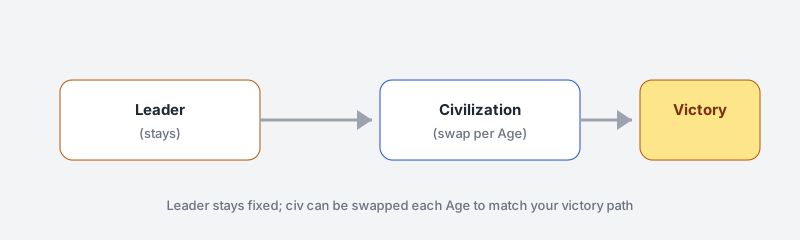
How to think about pairings
A leader provides fixed bonuses; a civ provides era-specific traits. Their synergy decides your upper limit, so evaluate both halves of the pairing separately.
- Science: pick leaders that add science or production (Confucius, Ada) with science-flavored civs (Han, Egypt). Campus adjacency plus science multipliers is the core.
- Culture: pick great-work or tourism leaders (Isabella, Catherine) with civs strong in cultural buildings. Theater plus great works plus wonders combine.
- Military: pick leaders with combat and conquest bonuses (Napoleon, Friedrich) with expansionist civs (Rome, Mongolia). Commander system plus unit bonuses stack.
- Economic: pick trade or gold leaders (Cleopatra, Isabella) with economic civs (Rome, Mali). Trade routes plus resource control.
- Religion: pick faith leaders (Ashoka) with religious civs. Holy sites plus tenets plus spread.
Swapping civs at transitions
When a new Age begins you can switch civ to keep your bonuses pointed at the route you are sprinting, which is the single most powerful long-term play in the game.
- Antiquity to Exploration: adopt a seafaring civ (Norway) to grab new-world resources.
- Exploration to Modern: switch back to a finisher civ (America, Germany) for the final project.
- When swapping, preserve the bonus buildings and units from the prior Age.
- Time the swap with a Golden Age to stack both bonuses at once.
Synergy analysis
A good pairing does not just stack bonuses — it makes the leader's bonus and the civ's trait amplify each other, producing results neither could alone.
- Confucius (+production) plus Rome (district bonus) = an all-round production powerhouse.
- Napoleon (+military) plus Mongolia (cavalry bonus) = an extreme cavalry rush.
- Ada (+science) plus Han (Campus bonus) = doubled science output.
- Cleopatra (+trade gold) plus Rome (commercial bonus) = a gold empire.
When to break a pairing
Not every pairing survives contact with the map. If your starting position lacks mountains for a Campus, pivot the leader's bonus toward what the terrain supports rather than forcing a mismatch.
Reading the victory screen
Before committing to a pairing, open the victory progress screen and note who is closest to each win. Your pairing should both pursue your route and subtly block the leader in the route you fear most.
- If a rival leads culture, lean your pairing toward tourism denial via relics.
- If a rival leads science, rush your own space projects earlier than comfortable.
- If a rival leads military, keep a civ with defensive bonuses in your rotation.
- Use the pairing to contest, not just to win — denial is half the game.
A flexible pairing that can pivot one Age later is worth more than a perfect-but-rigid one, because the map and the diplomacy will surprise you.
Quick reference: default pairings
When unsure, fall back to proven defaults: Confucius with Rome for an all-round start, Ada with Han for a pure science game, Napoleon with Mongolia for domination, and Cleopatra with Mali for economy. These four cover the most common victories and are forgiving enough that a mistake in the mid-game rarely costs you the match entirely.